Savings vs Checking Account: Understanding the Key Differences in 2025
When managing your money, one of the most common questions people face is — Should I use a savings account or a checking account? Both serve different purposes, and understanding how they work can help you make smarter financial decisions. Whether you’re saving for the future or managing daily expenses, knowing the difference between these two essential bank accounts is key to effective money management.
In this comprehensive guide, we’ll compare savings vs checking accounts in detail, explain how each one works, and help you decide which is right for your financial goals. You’ll also discover the best accounts available in 2025, interest rate comparisons, and expert tips to maximize your money.
Why Understanding Savings vs Checking Accounts Matters
In today’s digital banking era, consumers have more options than ever before. From online banks like Ally Bank and Discover to traditional banks such as Chase and Bank of America, every institution offers different features and rates for checking and savings accounts.
However, many people use their accounts inefficiently—keeping too much cash in checking (which earns little or no interest) or locking all funds in savings (which limits access). Understanding the key functions and benefits of each can help you optimize your cash flow while earning more interest and avoiding unnecessary fees.
Overview of Checking and Savings Accounts
Before diving into the differences, let’s quickly define both:
- Checking Account: A transactional account used for everyday spending—like paying bills, shopping, and direct deposits. It allows unlimited access through debit cards, ATMs, and online transfers.
- Savings Account: A deposit account designed to store money safely while earning interest over time. It’s ideal for building an emergency fund, saving for goals, or earning returns on idle cash.
Both account types are FDIC insured up to $250,000 (or NCUA insured for credit unions), ensuring your money is protected even if the bank fails. Most financial experts recommend having both to balance accessibility and growth potential.
Example Scenario: Using Both Accounts Effectively
Let’s say you earn $5,000 monthly. You might keep $2,000–$2,500 in your checking account for bills, groceries, and day-to-day expenses, while transferring the remaining amount to a high-yield savings account to earn interest.
For example, if you save $2,000 in an account earning 4.5% APY (like the Amex High Yield Savings Account), you’d earn about $90 annually—without lifting a finger. Over time, that adds up significantly.
In the next section, we’ll explore what a savings account really is, how it works, and the types available in 2025 so you can start growing your funds efficiently.
What Is a Savings Account?
A savings account is a secure place to store money that you don’t plan to spend immediately. It helps you grow your funds through interest while keeping your money easily accessible when needed. Whether you’re saving for an emergency fund, a vacation, or a long-term goal, a savings account offers both safety and steady growth.
Most savings accounts are designed to help you earn interest on your balance while encouraging disciplined saving. Unlike a checking account, you typically don’t use your savings account for daily transactions. Instead, you deposit money periodically and watch it grow over time.
Key Features of a Savings Account
- Interest Earnings: The main advantage is the ability to earn interest on your balance. Online banks often offer high-yield savings accounts with rates exceeding 4% APY in 2025.
- Safety: Savings accounts in banks are FDIC insured up to $250,000 per depositor, providing peace of mind even if your bank closes.
- Accessibility: You can withdraw or transfer funds when needed, although some banks may limit frequent withdrawals to encourage saving.
- No Market Risk: Unlike stocks or mutual funds, savings accounts are not affected by market volatility, making them perfect for short-term goals.
Types of Savings Accounts
In 2025, banks and financial institutions offer multiple types of savings accounts, each tailored to specific needs. Let’s explore the most common ones:
- Traditional Savings Account: Offered by most brick-and-mortar banks with lower interest rates but physical branch access.
- High-Yield Savings Account: Available mostly online, these accounts provide significantly higher interest rates. Examples include the
Ally High Yield Savings Account and
Discover Online Savings Account. - Money Market Account (MMA): A hybrid between a savings and checking account—offering interest and limited check-writing or debit privileges.
- Certificates of Deposit (CDs): Ideal for long-term savings. You agree to lock your funds for a set period (e.g., 6 months to 5 years) in exchange for a fixed higher rate.
- Credit Union Savings Accounts: Similar to bank savings accounts but provided by member-owned institutions, often with slightly better rates and lower fees.
How Savings Account Interest Works
The interest rate on savings accounts is expressed as Annual Percentage Yield (APY). This reflects the total amount of interest you’ll earn in one year, including compounding. For example, if your account offers a 4.25% APY and you maintain a $5,000 balance, you’d earn around $212.50 in a year—without any risk.
Many online banks adjust rates monthly based on market conditions. You can track the best rates using reliable sources like
Bankrate’s Savings Rate Tracker.
Benefits of a Savings Account
- Emergency Fund Creation: Keep 3–6 months of living expenses for unexpected situations like job loss or medical emergencies.
- Safe and Reliable Growth: Earn interest while keeping your money protected under federal insurance.
- Automatic Transfers: Set recurring transfers from checking to savings to grow your balance effortlessly.
- No Maintenance Stress: Most online banks have eliminated minimum balance requirements and monthly fees.
Example of Smart Saving Strategy
Let’s say you open a High-Yield Savings Account with Amex earning 4.35% APY. If you deposit $10,000, you’ll earn roughly $435 in one year without taking any investment risk. Compare this to a traditional savings account paying 0.40%—you’d earn only $40 annually.
That’s a significant difference, proving why choosing the right savings account is crucial for long-term wealth growth.
In the next section, we’ll explore what a checking account is, its core purpose, features, and when it’s the better option compared to a savings account.
What Is a Checking Account?
A checking account is designed for daily money management — deposits, withdrawals, bill payments, and purchases. Unlike a savings account, it provides unlimited transactions and easy access through debit cards, checks, and digital banking tools.
Checking accounts are essential for everyday financial activities such as paying rent, shopping online, or transferring funds. They’re the foundation of modern personal banking, helping you manage income and expenses efficiently.
Key Features of a Checking Account
- Unlimited Transactions: You can deposit or withdraw money as often as needed, unlike savings accounts which may limit withdrawals.
- Debit Card Access: Most checking accounts come with a debit card for easy spending at stores or online.
- Direct Deposit: Employers can deposit your paycheck directly, saving you time and ensuring instant access to your funds.
- Online & Mobile Banking: Almost all checking accounts now include apps for tracking balances, transferring money, or paying bills instantly.
- FDIC Insurance: Like savings accounts, checking accounts are insured up to $250,000 per depositor per bank.
Types of Checking Accounts
Banks offer several types of checking accounts to fit different needs. Here are the most common in 2025:
- Standard Checking Account: Offers basic deposit and withdrawal options. Ideal for everyday banking needs.
- Interest-Bearing Checking Account: Earns a small interest rate, though lower than high-yield savings accounts. Great for those maintaining high balances.
- Online Checking Account: Provided by digital banks with lower fees and 24/7 access. Examples include
Chime and
SoFi Checking & Savings. - Student Checking Account: Tailored for college students with zero monthly fees and no minimum balance.
- Business Checking Account: For entrepreneurs who need to manage payments, payroll, and expenses in one place.
Advantages of a Checking Account
- Convenience: Immediate access to your funds anytime, anywhere.
- Bill Payments Made Easy: Automate recurring bills or set reminders via online banking.
- No Withdrawal Limits: Withdraw or spend without restrictions, unlike savings accounts which may limit transactions.
- Modern Tools: Many banks integrate with financial apps for better expense tracking and budgeting.
Downsides of a Checking Account
- Low or No Interest: Most checking accounts offer minimal returns compared to savings accounts.
- Potential Fees: Overdraft fees, maintenance charges, and ATM fees may apply if not managed carefully.
- Encourages Spending: Since funds are easily accessible, it can be harder to save consistently.
Example of Smart Checking Account Usage
Suppose you open a Discover Cashback Debit Checking Account. This account offers 1% cashback on up to $3,000 in monthly debit card purchases — making your everyday transactions more rewarding while maintaining zero monthly fees.
Alternatively, digital banks like SoFi Money or Chime combine checking and savings features in one, giving you flexibility with no hidden costs.
Now that you know how checking and savings accounts work individually, the next section explains their key differences — so you can decide which one suits your financial goals.
Key Differences Between Savings and Checking Accounts
While both savings and checking accounts are essential for managing your finances, they serve very different purposes. Understanding these distinctions helps you make smarter money decisions and maximize your financial growth.
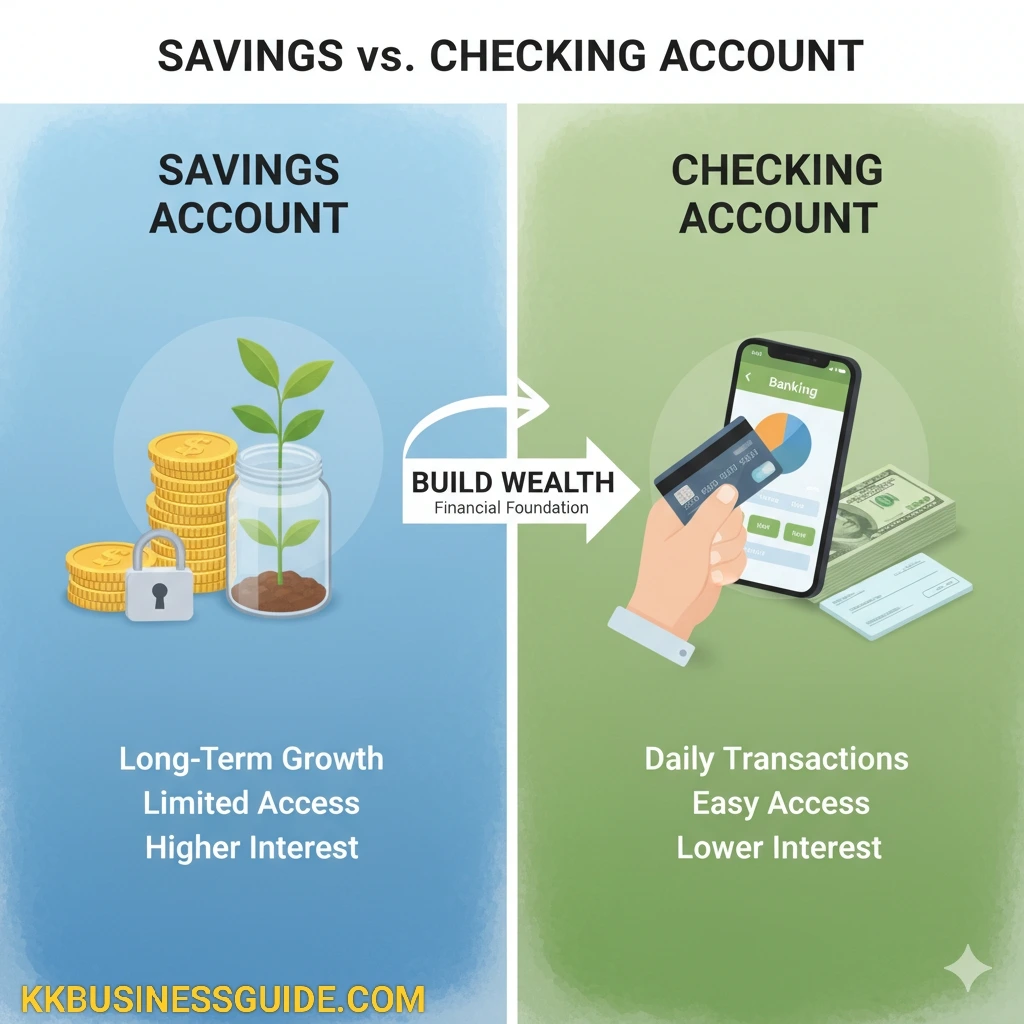
Checking vs Savings Account: A Quick Comparison
| Feature | Checking Account | Savings Account |
|---|---|---|
| Purpose | For everyday spending, payments, and deposits. | For storing money and earning interest over time. |
| Interest Rate | Usually low or zero. | Higher APY, especially in high-yield savings accounts. |
| Withdrawal Limits | Unlimited transactions. | May limit frequent withdrawals or transfers. |
| Accessibility | Immediate access via debit cards, checks, or ATMs. | Accessible but not meant for daily use. |
| Fees | Possible overdraft or maintenance fees. | Usually low or no fees in online banks. |
| FDIC/NCUA Insurance | Up to $250,000 per depositor per institution. | Same federal insurance coverage applies. |
| Ideal For | Daily transactions, salary deposits, and bill payments. | Building an emergency fund or saving for goals. |
When Should You Use a Checking Account?
A checking account is ideal for daily financial activities. You should use it for paying bills, making purchases, and handling regular expenses. If you prefer instant access to your funds, checking accounts offer flexibility and convenience. Modern banks even reward spending with cashback and no monthly fees.
Some of the best checking accounts in 2025 include:
- SoFi Checking & Savings – Earn up to 4.60% APY and get early direct deposits.
- Discover Cashback Debit – 1% cashback on eligible debit card purchases.
- Chime Checking – No hidden fees and automatic savings transfers.
When Should You Use a Savings Account?
A savings account is perfect for setting aside money for the future. Whether you’re building an emergency fund, saving for a car, or preparing for retirement, this account type helps your money grow safely over time.
Top high-yield savings accounts to consider in 2025:
- American Express® High Yield Savings Account – Earn competitive APY with no monthly fees.
- Ally Bank Online Savings Account – Excellent mobile tools and strong interest rates.
- Discover Online Savings Account – 24/7 access, no fees, and trusted reliability.
Why You Might Need Both
Most financial experts recommend maintaining both a checking and a savings account to balance liquidity and long-term growth. For example, keep your salary and regular spending in a checking account while transferring extra funds into a high-yield savings account each month.
This setup helps you separate spending from saving and ensures your money grows while staying accessible. You can even automate transfers — for instance, moving $100 weekly from checking to savings using your bank’s mobile app.
Example: A Smart Banking Strategy
Imagine you use SoFi Checking & Savings for your daily transactions and link it to an Ally High Yield Savings Account. You’ll earn interest on your savings while enjoying fee-free transactions and automatic balance management — the best of both worlds.
In the next section, we’ll explore how to decide between a savings and a checking account based on your goals, habits, and lifestyle.
How to Choose Between a Savings and Checking Account
Choosing between a savings account and a checking account depends on your financial goals, lifestyle, and how you manage money day-to-day. Both serve important but different purposes — while checking accounts are for accessibility, savings accounts are for growth and security.
Here’s how you can decide which one works best for you, or why having both might be the smartest strategy in 2025.
1. Identify Your Primary Financial Goal
Ask yourself what you want to achieve with your money. If your goal is to make daily payments, pay bills, and use a debit card, then a checking account is your go-to. However, if you’re looking to grow your funds and earn interest safely, a high-yield savings account is the better option.
For instance, someone saving for a car or emergency fund should prioritize a savings account like the
American Express® High Yield Savings. On the other hand, for managing routine expenses, the
Discover Cashback Checking Account is an excellent choice.
2. Compare Interest Rates and Fees
One of the biggest differences between the two account types lies in interest rates and fees.
- Savings Accounts: Offer higher APYs (up to 4–5% with online banks like Ally Bank and Discover Bank).
- Checking Accounts: Usually offer low or no interest but may provide cash-back or fee-free ATM access.
When choosing, always check the APY, monthly maintenance fees, minimum balance requirements, and whether the account has ATM reimbursements.
3. Evaluate Accessibility
If you need immediate and unlimited access to your funds, a checking account is ideal. You can pay bills, withdraw cash, or transfer money without restrictions. However, if you tend to overspend, it’s smarter to store extra money in a savings account to prevent impulse withdrawals.
Many modern digital banks like SoFi and Chime offer integrated checking and savings accounts, giving you the flexibility to manage both from one app.
4. Consider Security and FDIC/NCUA Protection
Both account types are insured up to $250,000 by the FDIC (for banks) or NCUA (for credit unions). This ensures your deposits are safe even if the institution fails. Always verify that your financial provider is federally insured before opening an account.
You can check FDIC membership using the official FDIC BankFind tool at
banks.data.fdic.gov/bankfind.
5. Check for Digital Features and Mobile Access
Today, mobile banking is a must. Look for banks offering advanced apps that allow you to deposit checks, schedule transfers, set up alerts, and monitor spending. Top-rated banks for mobile tools include:
6. Combine Both for Maximum Benefits
Rather than choosing one, the smartest approach is often to use both accounts strategically:
- Deposit your salary into a checking account for regular expenses and bill payments.
- Set up automatic transfers to your savings account each month to earn interest and build your emergency fund.
For example, you can keep $1,000 in checking for bills and daily spending and move any excess into a high-yield savings account like
Amex High Yield Savings to grow your balance passively.
7. Understand Your Spending Habits
If you’re someone who tends to use a debit card frequently, a checking account with cashback rewards is a great fit. However, if you’re a saver or working toward specific goals, a savings account ensures that your money earns interest while staying separate from daily spending.
Creating this distinction helps you maintain discipline and prevents unnecessary withdrawals that slow down your financial growth.
Expert Tip:
Financial advisors recommend maintaining both account types with automatic savings transfers. It creates a system that saves without effort, helping you reach your goals faster while keeping liquidity for daily needs.
In the next section, we’ll review the best banks offering both savings and checking accounts in 2025 — helping you choose institutions that deliver the highest value and convenience.
Top Banks Offering the Best Savings and Checking Accounts (2025)
Finding the right bank can make a huge difference in how your money grows and how easily you can access it. The best banks in 2025 not only offer competitive interest rates but also zero fees, digital convenience, and powerful mobile tools. Here are some top-rated options that combine both savings and checking accounts efficiently.
1. SoFi Bank
SoFi Checking and Savings is one of the most popular all-in-one banking options in 2025. It combines both account types seamlessly, offering competitive interest rates and user-friendly digital features.
- APY: Up to 4.60% with direct deposit
- Monthly Fees: $0
- ATM Access: 55,000+ fee-free ATMs
- Bonus: Earn a welcome bonus of up to $300 with qualifying deposits
SoFi also includes features like early paycheck access, automatic saving, and strong mobile budgeting tools — making it ideal for both personal and business users.
2. Discover Bank
Discover Bank offers both a Cashback Debit Checking Account and a High-Yield Savings Account, known for simplicity, reliability, and no hidden fees.
- APY: Around 4.25% on savings
- Cashback: 1% on up to $3,000 in monthly debit purchases
- Minimum Balance: None
- FDIC Insurance: Yes, up to $250,000
Discover’s digital tools are top-notch, and customer support consistently ranks among the best in the industry. It’s a great choice if you want a trusted, fee-free online bank with rewards.
3. Ally Bank
Ally Bank continues to dominate online banking with its seamless interface and strong interest rates on both checking and savings accounts.
- APY: Around 4.20% on savings, small interest on checking
- Minimum Balance: $0
- Monthly Fees: None
- Additional Features: Round-up savings feature automatically transfers spare change to your savings
Ally is perfect for users who prefer full online management, fast transfers, and competitive returns. It’s also one of the most transparent banks with zero hidden costs.
4. American Express® Bank
The American Express® High Yield Savings Account is a top-tier option for savers. While it doesn’t offer traditional checking, it integrates smoothly with external accounts for transfers, making it ideal for building savings.
- APY: Around 4.35%
- Minimum Balance: None
- Fees: No monthly maintenance fees
- Transfers: Easy online or mobile app transfers to linked accounts
American Express Banking focuses on helping users grow their funds safely with federal protection and strong digital features. It’s especially great for those who prefer to keep savings separate from spending.
5. Capital One Bank
Capital One 360 Checking and 360 Performance Savings accounts are an excellent combination for users who want both flexibility and rewards.
- APY: Up to 4.30% on savings
- Monthly Fees: $0
- Mobile App: Highly rated for managing transfers, spending, and savings goals
- Extra Benefit: Easy integration with Capital One credit cards for total financial management
Capital One’s system is ideal for users who want a full-featured online and branch-based experience with top-tier customer service.
6. Chime
Chime is one of the best options for users seeking simplicity and automation. It combines checking and savings accounts that work perfectly together with features like automatic round-up savings and no overdraft fees.
- APY: Around 2.00% on savings
- Fees: No monthly or overdraft fees
- ATM Access: 60,000+ fee-free ATMs
- Bonus: Early access to direct deposits up to two days sooner
Chime is perfect for beginners, freelancers, and mobile-first users who prefer automation and easy money management without traditional banking hassles.
7. Credit Unions Offering Strong Savings and Checking Rates
Credit unions like Alliant Credit Union and Navy Federal Credit Union are also solid options for those seeking higher rates and a community-focused approach.
- APY: 4.00% or more on savings accounts
- Benefits: Lower fees, better customer service, and member-only perks
- Downside: Membership may require eligibility (location or employer-based)
Quick Recommendation
If you want an all-in-one solution, choose SoFi for the best combination of checking and savings with top-tier digital tools. However, if your goal is maximizing savings interest, Ally or American Express® are the best picks in 2025.
In the next section, we’ll wrap up with a detailed conclusion to help you decide how to build the best banking strategy for your lifestyle and goals.
Conclusion: Choosing Between Savings and Checking Accounts
When it comes to managing your money wisely, both savings and checking accounts play crucial but very different roles. The key isn’t just choosing one — it’s understanding how to use both effectively to balance convenience and growth.
Your checking account is designed for everyday financial activity — paying bills, making purchases, and withdrawing cash. It provides liquidity, flexibility, and easy access. However, it’s not ideal for long-term growth since interest rates are typically low.
Your savings account, on the other hand, is a powerful tool for building financial security. It’s where your emergency fund grows, where you set aside money for goals, and where you can earn interest while keeping funds safe. Thanks to high-yield savings accounts offered by online banks, it’s now easier than ever to earn competitive returns without any risk.
Best Strategy for 2025
The smartest approach is to maintain both accounts at the same or connected financial institution. This allows for:
- Instant transfers between checking and savings
- Automated saving tools to grow your balance effortlessly
- Unified mobile banking apps for easier management
- Bonus interest or rewards for linked account users
For example, banks like SoFi, Ally Bank, and Discover Bank offer dual-account systems that provide high yields, zero fees, and simple automation — helping you manage, spend, and save all from one dashboard.
Pro Tips to Get the Most from Both Accounts
- Set up automatic transfers from your checking to savings each month to build consistency.
- Use your savings account strictly for emergency funds or planned goals — not daily expenses.
- Take advantage of online banks for higher interest and lower fees.
- Regularly compare APYs (Annual Percentage Yields) and switch if your bank’s rates drop.
- Use your checking account with cashback debit options to earn small rewards on everyday spending.
Final Thoughts
In the end, it’s not about checking vs savings — it’s about using both to create a financial system that works for you. Your checking account keeps your money moving, while your savings account helps it grow.
Whether you’re just starting to save or looking to upgrade your current accounts, the best time to take action is now. Choose a high-yield savings account that pays you to save, and pair it with a low-fee checking account for everyday spending — the perfect combination for 2025 and beyond.
Ready to Take Control of Your Finances?
Start by exploring the top online banks today. Whether your goal is saving more, spending smarter, or simply earning better interest, the right combination of accounts will help you reach your financial goals faster.
Stay financially smart, compare rates regularly, and make your money work as hard as you do!
Disclaimer: This article is for educational purposes only and does not constitute financial advice. Always review current bank terms and interest rates before opening an account.